
Your teenager comes to dinner with the idea: a clever phone case, an app for finding study partners, or a tutoring service for kids down the street. They’re lit up and talking fast. You feel proud, then a quiet question you don’t want to ask: Is this real, or is this just another Friday?
Beneath that question is another: You want your teen to make something that matters to someone else—and to have something of their own to point to when applications come around, beyond another list of clubs.
I’ve sat on both sides of that table. I spent years in corporate market research, learning what customers really want before anyone spends money, and I’ve also been the person with the exciting idea. I learned that the gap between an idea and a real business is smaller than most people think. You cross it with a skill, not a plan: a few good conversations and one real payment.
Here’s how I’d walk a teenager through it.
1. Start with a problem, not an idea
An idea feels like a starting point, but it’s really a guess about what someone else needs. The underlying problem is what you can test.
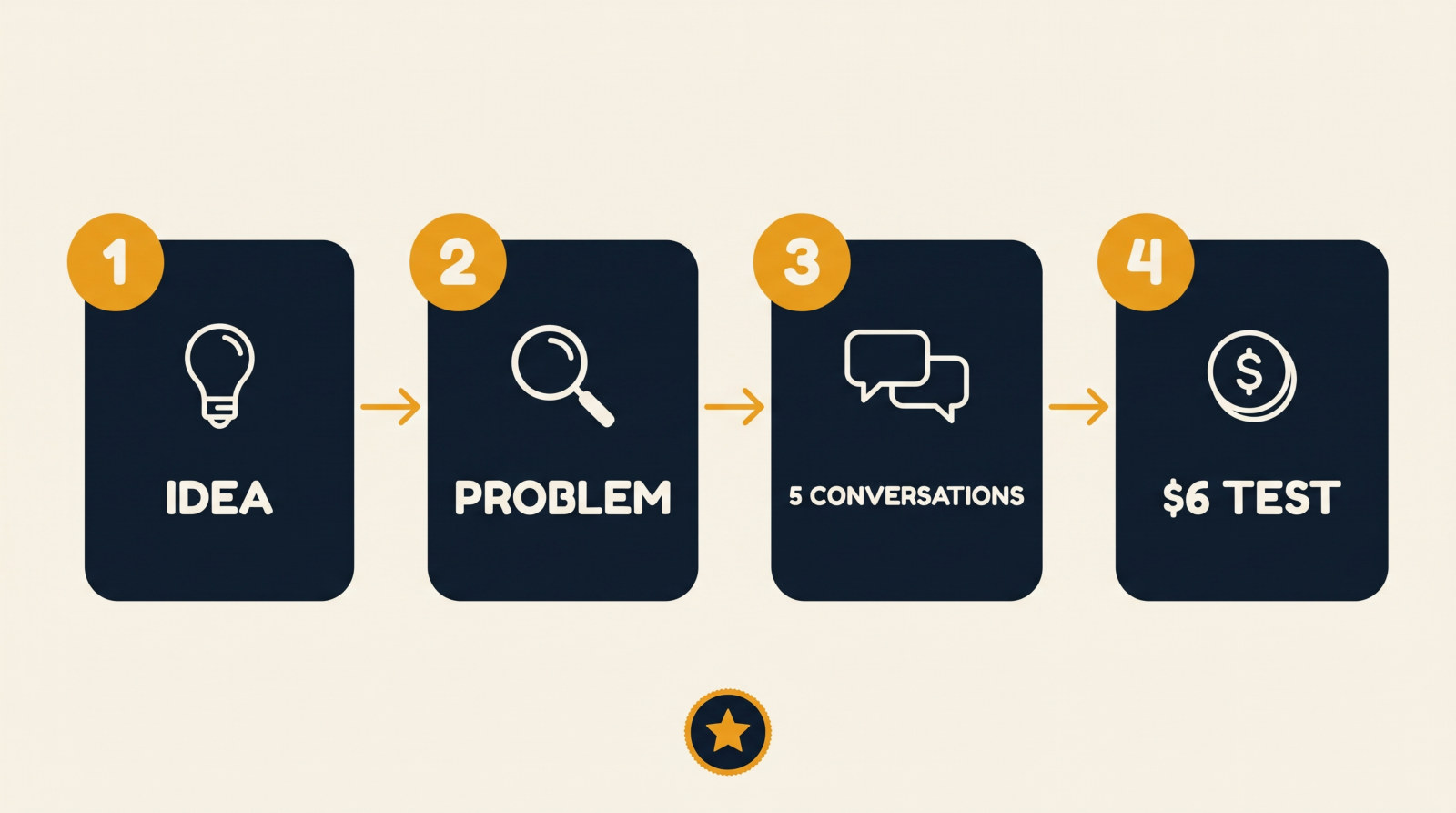
At Starbound Founders, we put it this way: ideas are cheap, problems are gold. An idea might be "I'll make a study app." A problem might be "my friends lose their notes the night before a test." The second describes a problem someone other than your teen has, which is exactly why it’s useful. They can ask whether it’s real.
A simple example. Picture Priya, a college sophomore, whose idea is a meal-prep app. We ask her to set the idea aside and identify the problem she noticed: students on her campus get hungry between 9pm and midnight, when the dining hall is closed. That’s something she can test. The app is just one possible solution.
2. Talk to real people before building anything
Many teens skip this step—and so do adults, myself included.
The key is knowing what to ask. Asking "Would you use my app?" often gets a polite yes. People are kind, but they can’t predict what they’ll do in the future. Instead, ask about the past: "Tell me about the last time you were hungry late at night. What did you do?"
This approach comes from The Mom Test by Rob Fitzpatrick (book summary). Its core advice is to ask about specific past events rather than future opinions. We use it in our program because it feels gentle: nobody has to pitch. Your teen just listens, writes down people’s exact words, and looks for patterns.
Priya talks with five classmates she already knows. Four say they order delivery and complain about the fees; one says she skips dinner. That’s real information, gathered through five conversations—not a spreadsheet.
3. Test a payment, not just interest
Here is the part I wish more people were told early.
A friend of mine once had an app idea. She did what looked like the right thing: she talked to people, and they confirmed the problem. They nodded, they said it was annoying, some said they would love it. Nobody paid. It taught both of us that confirming a problem and paying to fix it are two different things, and it is why I now test the payment, not just the pain.
For a teenager, a payment test can be very small. Priya texts the four classmates who complained about delivery fees: "I'm going to make late-night snack boxes this Thursday for $6. Want one?" If two say yes and hand over $6, she has learned more than a month of planning could have told her. If no one does, she has lost nothing but an afternoon, and she knows to ask a different question.
Sometimes the answer is "not yet," and that is a good answer too. It tells you what to adjust before money and time go into the wrong thing.
4. Build the smallest version that can be tested
Once someone says yes, then you build, and you build the smallest thing that does the job. Priya does not need an app. She needs a box, a handful of snacks and a way to deliver on Thursday.
A real founder example: Sara Blakely started Spanx with about $5,000 in savings, and she spent roughly two years developing the product while she still held her day job at Danka (Fortune). When Neiman Marcus's buyers offered her ten minutes in person, on the condition that she pay for her own trip, she went, and showed the buyer how the product worked right there. The product launched at Neiman Marcus in 2000 (Fortune; Wikipedia). She did not begin with a large plan or large funding. She began with one working product and one customer to show it to.
The lesson for a teen is not "become Sara Blakely." It is that the first version of anything real is usually smaller and scrappier than the story people tell afterward.
5. Keep a record of what actually happened
Every conversation, every no, every first sale: write it down. This is the part that quietly becomes valuable.
A teen who can say "I interviewed 12 people, learned that late-night delivery fees were the main complaint, ran a test with 6 orders and earned $36" has done something meaningful. They found a problem that mattered to real people and tried to help. Admissions readers, scholarship committees and hiring managers can all follow a story like that. What it gives your teen is something impactful to talk about, in their own words, which goes a good deal further than a polished paragraph about being passionate.
6. Where parents fit in
You do not need to be an entrepreneur to help. In fact, the most useful role is the one you probably already play: calm, curious and a little bit skeptical. Ask questions rather than give verdicts. "Who told you that?" is better than "I don't think that will work."
And let a no be a no. A teen who hears three people say "I wouldn't pay for that," and finds that survivable, has learned the most important founder skill there is.
What you can do this week
- Ask your teen for the problem, not the idea. "Who has this problem, and how do you know?"
- Suggest five short conversations with people they already know, asking about the last time the problem came up.
- Agree on one tiny payment test with a small cost and a small ask, like a $5 pre-order to a friend, with your say on safety and who they are selling to.
FAQ
My teen has an idea but no money. Can they still start?
Usually, yes. The first steps (conversations and a small test) cost close to nothing. Early on, the thing worth investing is time. Any money should wait until someone has said yes.
What if the idea doesn't work?
Then your teen finds out early and cheaply, which is a good result. Most ideas need to change shape after meeting real customers. Learning that at 16 with a $6 snack box is a lot kinder than learning it later with more at stake.
Is my teen too young to start a business?
Age matters less than the first question: is there a real problem and a real person who has it? There are practical things to check, such as local rules for selling certain products and whether a parent needs to be involved in any accounts. We cover these with families.